Thursday, August 14, 2014

Review: Isla and the Happily Ever After

!!!!!!!!!!!!!!!!!!!!!!!!!!!!!!!!!!!!!!!!!!

That's really the only way I can express how I feel about this book, with maybe a couple <3s thrown in for good measure. I want to live in this series.


For three years now, Isla Martin has been seriously crushing on Josh Wasserstein, one of her classmates at SOAP. He's been dating another girl, though, and she's painfully quiet, so she hasn't been able to do anything about it.

Until now.

Isla strikes up a conversation with Josh while high on painkillers (legally, she got her wisdom teeth out) in NYC, which leads them into a tentative friendship once they get back to school. Isla even gets assigned to Josh's old dorm room, a coincidence her romantic soul really enjoys.

Josh seems to be acting a little tentative around her, though, and she finally discovers why: he thinks she's dating her best friend, Kurt, since they spend so much time with each other. She quickly sets him right, and they begin a whirlwind relationship, exploring Paris and Barcelona with each other on some seriously impressive dates.

So of course it all goes downhill when Josh gets expelled for finally breaking too many rules at SOAP. Sneaking out to other countries is totally against school rules, and combined with his three previous years of exploiting his Jewish heritage and skipping out on his homework, the school can't give him any more chances. He's sent back to NYC to go on the campaign trail with his politician father, while Isla's left in Paris.

Isla's afraid Josh only likes an image of her he's created in his head and that they only started dating because they were both single at the same time, and her doubts aren't helped any by the new distance between them and the autobiographical comic book he gives her, where his ex is plastered all over the book but Isla's only in eight pages at the end. Over Christmas break she picks a fight with Josh and breaks up with him, thinking it'll be better for them both in the long run.

Except it's not. Now Isla's still miserable but even more alone, thanks to how she's been treating Kurt and Hattie. Since Isla devoted so much of her time to Josh, Kurt found new friends who share some of his other interests, and an ex-friend of hers tells her that she's been treating Hattie more like a child than a sibling ever since they got back to school. Isla slowly makes amends, though, repairing both of her relationships and realizing that her inner self isn't always right about other people.

At the end of the novel, Isla gets a phone call from Josh, saying he and some friends of his (aka Anna, St. Clair, Lola, Cricket, and Meredith) are all in Paris for a bit before going off to the Winter Olympics, and that they'd all love to see her. Will the promised happily ever after finally occur?

(Yes. Duh. Sorry, that was a terrible question.)

Anyways, I loooooooved Isla. I think it's actually my favorite of the three. Isla's personality really matches up with my own, so seeing her learn and grow was fascinating (and potentially helpful) to me. I also adored the Anna/St. Clair moment at the end - not gonna spoil it, but I definitely had to hold in a squeal of glee.

Another thing I appreciated about this book: Kurt. I knew before it was explicitly stated that he was autistic, and I thought it was so fantastic that he was included. He's not tokenized in any way, nor does Isla see herself as some kind of saint for being best friends with The Autistic Kid. He's just Kurt, the boy she's known since childhood, and they're pretty much each other's only friends for a large portion of the book. There are even references to Kurt having a type when it comes to girls, subtly refuting the "people on the autism spectrum are too different to feel romantic attraction" idea that goes around. I'm not trying to say Kurt's the best example of diversity to ever be written ever, but he was definitely written well.

Finally, I'm so happy that the basic scheme of this novel was different from both Anna and Lola. Both of those novels kind of followed the same pattern where the girl and the boy meet, but circumstances prevent them from getting together until the end of the story. While Anna and Lola's stories diverged enough that I didn't feel like I was reading the same idea with the names changed, I was still glad to see that Josh and Isla got together pretty early in the story, and then had to deal with the troubles that come when you'd like to sustain a relationship. It was a nice change of pace.

Overall, Isla and the Happily Ever After is superb. The characters are wonderful, the plotline's a bit different than Perkins' other books, and the appearances by her previous protagonists wrap up their stories in the best possble way. I know this is the last book she plans to write in this series, but that doesn't stop me from wanting more. Five stars.

Wednesday, August 13, 2014

Review: The Sisterhood of the Traveling Pants series

Side note before I start the actual review: what are the odds of me finding my original copy of the first book now that I've gone out and gotten a replacement? I'm sure the next time I look, it'll just be there taunting me.


(Wow, Amazon actually had a composite for that. Thanks, Google Image Search!)

I'm sure everyone and their brother has read this series/knows what it's about by now, so I'm going to try to do a very TL;DR summary of the books. Ready? Okay!

Carmen, Lena, Tibby, and Bridget are lifelong best friends about to spend their first summer apart. As they're packing, they unearth a pair of jeans Carmen got secondhand a few months back, and each of them end up trying the pants on. Somehow, mysteriously, the pants fit all of them, though they have different heights and builds. They decide to mail the Pants (now worthy of a capital P) to each other throughout the summer in order to feel more connected and allow the Pants to experience all their adventures, even if they can't all be together to do it themselves.

The basic summary of the girls' exploits in book one: Lena meets a boy, but pushes him too far away. Bridget meets a boy and lets him in too much. Tibby meets a girl who teaches her more about life than she'd thought was possible, and Carmen meets her father's new family, to her surprise and dismay. Each girl learns a little more about herself and those around her thanks to the exploits they have in the Pants.

The next three books continue on in similar veins. Lena has to learn how to live her life without centering it around the whims of a man who can't always be around her. Bridget loses herself for a bit, but eventually learns to balance taking care of herself and letting others take care of her without depending on them too much. Tibby continually learns that she has to face her demons head-on if she wants them to really go away, and Carmen eventually realizes that change is a good thing, especially for her family. She also comes to terms with a toxic friendship.

The last book ends with the sisters back together for the first time in months after a minor tragedy happens. It rocks their world for a while, but they soon realize that it was exactly what they needed.

We don't talk about book five.

It had been years since I'd reread this series, and I'd kind of forgotten how good they are. I love the little quotes Brashares intersperses between the chapters, and it's fun seeing how the messages of those quotes play out in the actual story. While the references are a bit dated (CosmoGirl? I'd almost forgotten that even existed), the basic lessons and contents of the story feel timeless.

My only beef is that sometimes it feels like the girls never really grow from their experiences. Tibby and Carmen are my two prime examples: Tibby has to re-learn that sealing herself off from her emotions every novel isn't healthy, while Carmen always gets angry or bitter about any new people entering her family, at least in the first three novels. I've got next to no experience with psychology, so maybe it really does take people that long to change, but over four years - especially when the girls go off to college - I'd think that they wouldn't get so easily stuck in their bad habits. At some point, I feel like they'd kick themselves in their rears and realize that their old behaviors aren't going to help them.

Still, the books are immensely enjoyable, and every girl has her moments of relatability, even if you don't identify closely with one of them in particular. Four and a half stars.

Tuesday, August 12, 2014

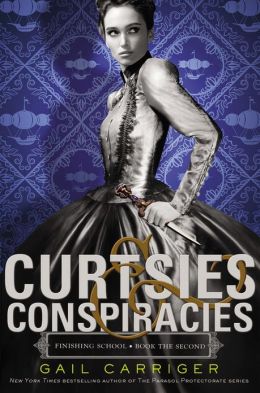
Review: Curtsies & Conspiracies

Wow, it's been a while. Sorry about that, I've just been busy! (And also a little lazy. Sue me.)

Anyways, I'll try to get back on more of a normal blogging schedule this week. Starting with:


Curtsies & Conspiracies, the second novel in the Finishing School series. Sophronia's back for another rousing adventure at Mademoiselle Geraldine's, this time with a couple new intrigues. The curious prototype from the last novel is still causing a stir for Sophronia and her friends, but there's another source of uproar, too.

Boys.

A few young men from Bunsen's, their brother school, are spending the term on board the girls' dirigible, along with one of their professors, Algonquin Shrimpdittle. Sophronia knows that some of the boys are being trained to take over for their fathers in their anti-supernatural clubs, but that doesn't stop her from flirting with Felix, a young lord who's definitely interested in her.

Of course, multiple problems arise over the course of the book. Vieve's gotten permission to disguise herself as a boy and attend Bunsen's, but Shrimpdittle knows she's a girl. Sophronia agrees to sabotage him in exchange for Vieve's gadgetry, but that deal ends up affecting one of the people around her in an unfortunate way. On top of that, Sophronia thinks her friend Soap the sootie is crushing on her, but she doesn't know how she feels about him, especially when she factors in Felix's attention. Worst of all, Dimity and her brother get kidnapped by the Westminster vampire hive, but no one seems willing to help her break them free.

This is really not what Sophronia was expecting when she learned she was going to finishing school.

First of all, I apologize for the short summary! It's been a couple weeks since I read this, so my memory's lost all the details.

I can recall that I loved this book, though. Common YA tropes - especially the Sophronia/Felix/Soap love set-up - are twisted enough to make them interesting and applicable to such a different setting, and I think it's great. I'm super glad that what could be a boring "does she love person A or B?" love triangle isn't reduced to that at all. Sophronia knows she has bigger problems that figuring out which boy to date, for one, and for two, she's genuinely in a pickle. She knows she's not really into Felix, but she's not above flirting with him and trying to be his friend, and she's concerned about ruining her best-buddies relationship with Soap if their feelings get more intense. While it's definitely a plot point, the romance doesn't overshadow the action - if anything, it fuels it, driving the story onwards. It's very well-crafted, in my opinion.

Also, Lord Akeldama's back in this book! He's one of my favorite side characters from Alexia's books, so even though he's not in Curtsies & Conspiracies a lot, it's still nice to see him. I get the feeling he'll come into more prominence in the next two books, too, which is exciting.

Overall, Curtsies & Conspiracies is a fun showcase for Sophronia's budding talents as a spy, and it never gets bogged down in unnecessary romance or action. It zips right along, and I didn't want it to ever finish. Five stars.

Thursday, August 7, 2014

Review: Etiquette & Espionage

Remember how I said I was going to talk about Gail Carriger's other series, the Finishing School books, later?

It's later.


After a surprise visit from the headmistress, Sophronia Angelina Temminnick's mother is shipping her off to Mademoiselle Geraldine's Finishing Academy for Young Ladies of Quality. Sophronia's always been more interested in sneaking around the house to eavesdrop than becoming a proper young lady, so she's not super interested in this prospect, understandably.

At least until the flywaymen attack.

It's revealed that the "headmistress" was actually a disguised student named Monique, and the robbers are demanding she hand over the prototype, whatever that is. When they wrestle her out of the carriage, it's up to Sophronia, another recruit named Dimity, and Dimity's brother Pillover to rescue Monique and get back on course to their respective schools.

And that's not even the biggest reveal of the day: for one, Mademoiselle Geraldine's isn't a building - it's a floating dirigible. For two, it's not just a normal finishing school. It's a school for intelligencers, and Sophronia's their newest covert recruit, one of the few students who doesn't have a family history of attendance.

Sophronia's got natural talent for spying, though, and she starts to put it to some unsanctioned uses: namely, figuring out what exactly the prototype is, and why Monique would go so far to take it for herself. After all, Monique ended up sabotaging her entire academic career for it, since she's now back in the debut classes with Sophronia and her friends.

With some assistance from a mechanimal, the sooties, and an ingenuitive little girl named Vieve, Sophronia figures out that things should come to a head the night of her older sister's coming out ball. Will she and Dimity be able to rescue the prototype without revealing too much of what they're actually learning at finishing school? (Since there's a book two, signs point to yes.)

Etiquette & Espionage is a combination of some of my favorite tropes: girls attending secret spy schools, historical AUs, and femininity as its own kind of power. It's also got the bubbly, quirky writing style of the Parasol Protectorate series, so it feels fun to read, especially when characters from Carriger's original series make appearances in this YA spinoff. Seeing the familiar universe in a different context is one of my favorite parts of this series.

Carriger's talent for writing unique, fun characters is still going in the Finishing School series, too. The teachers especially are all wildly different, and they kind of feel like Hogwarts professors mixed with particularly flamboyant stage performers. Since I really love side characters with big personalities, I'm consistently enamored with Carriger's books.

Overall, Etiquette & Espionage is a supremely entertaining novel that doesn't really depend on prior knowledge of Carriger's other books to be enjoyable. If its description strikes your fancy more than Alexia's books do, feel free to jump right in. Five stars.

Tuesday, August 5, 2014

Authors Who Need More Love: Gail Carriger

I will go on about every book she's written until I am blue in the face because everyone should read these books they should have read them yesterday.

(Also, I'm only going to talk about the Parasol Protectorate books - I reread the Finishing School books more recently, so they'll get a separate review. Not sure if I'm going to do them individually or together yet, though.)

Photo cred: here

Do you like vampires, werewolves, Victorian romances, and alternate historical timelines? Then everything about this series is for you.

The protagonist is Alexia Tarabotti, a preternatural. Preternaturals are basically the opposite of supernaturals like vampires and werewolves - they have no soul, while supernaturals have an excess. (The excess of soul is what allows people to become supernatural in the first place.) Alexia can turn a vampire or werewolf human if they make skin-to-skin contact, though no one really understands how or why that occurs. Since she's a woman of decent social standing, the Bureau of Unnatural Registry mostly just wants to keep her out of the way of their day-to-day operations.

Which is all well and good until they remember that Alexia is awesome at not following instructions.

Alexia is also naturally curious and very well-read on current scientific theories, making her an almighty pest to Lord Conall Maccon, the head of BUR. (Can you tell where this is going?) They fight, banter, and bicker like an old married couple, yet somehow manage to have some spectacular miscommunications about their true feelings for each other. It also doesn't help that Lord Maccon's an Alpha werewolf, and thus has different protocols for courtship than Alexia is used to.

On top of all the romantic turmoil, Alexia's being followed around London by strange automatons that no one can seem to trace back to their owners. BUR can't send their usual agents to watch over her on the night of the full moon, naturally, so she goes to visit her vampire friend Lord Akeldama then. He's one of the oldest vampires around, so she figures it'll be a pretty safe visit.

Until the automatons strike, kidnapping both of them. When Alexia awakens, she's in an unfamiliar house full of mad scientists who'd like to use her preternatural abilities to terminate supernatural beings for good, starting with Lord Akeldama. Oh, and they've also kidnapped Conall and the rest of his pack, too. Alexia's options are limited, but with a little ingenuity, she manages to get to Conall and work together to save their loved ones.

And that's just book one.

Books two through five take Alexia all over the world as she discovers new facets and limitations of her abilities, such as her reaction to the mysterious God-Breaker Plague and what exactly happens when a supernatural man and a preternatural woman have unprotected sex. Even when she'd like them too, the adventures just never really stop for Alexia and her friends.

So there's the rundown of the plot. Still need convincing?

How about this: basically none of Alexia's friends are heterosexual. Lord Akeldama's gay and keeps a coven full of handsome dandies, as is Professor Lyall, Conall's Beta. Alexia's own father had affairs with both men and women, though she never actually knew the man, and Alexia's close friend Genevieve Lefoux is a lesbian who is not subtle about her attraction to Alexia. (Heck, Alexia even experiences a little attraction of her own to Genevieve, but she quashes it down because she's married.) There's also a love story that develops between Lord Akeldama, his favorite coven member Biffy, and Professor Lyall, though not until a little later in the series.

What's best, though, is that none of the tension is caused by someone realizing they're gay and then spiraling into a shame crisis because of the era. While I wouldn't say any of the homosexual characters are announcing their sexualities from the rooftops, they're also not using each other as beards to keep up any charades. More of the problems are caused by vampire-werewolf relations than anything else, and I love that.

All of the characters are genuinely entertaining, too. Alexia's best friend Ivy speaks in malapropisms constantly, Lord Akeldama uses the most ridiculous endearments, and Alexia's mother and stepsisters can be almost caricatureish in their adherence to proper standards of behavior sometimes. The mishmash of characters and settings is set aloft by Carriger's writing, too, which is reminiscent of actual Victorian novels but with a decidedly modern sense of humor.

The final thing I want to mention about these novels is how cool I find the concept. Instead of keeping the supernatural in hiding like in every other vampire/werewolf novel, Carriger puts them at the forefront of society. Vampires dictate what's trendy. Werewolves are the premier military leaders. Ghosts can be used to investigate crimes. There's also some pushback from more conservative groups like the mad scientists I mentioned earlier or the Knights Templar, who fear the supernatural and want to send them back into hiding/eradicate them as is God's will. It's really interesting to me to see how Carriger reinterprets actual history to include supernatural creatures and how that would change things, and I'm hoping her upcoming Custard Protocol series expands more on that.

Overall, the Parasol Protectorate novels are a flurry of fun, adventure, and romance, and I want them to become movies already. Five stars.

Monday, August 4, 2014

Review: The Jewel

A sci-fi YA novel that I actually enjoyed reading? Am I hallucinating? Is it Christmas? 

(Also, it's an ARC, so keep your eyes peeled on September 2nd!)


Violet Lasting is about to become no more.

She's one of two hundred girls capable of being a surrogate for the upper class women in her society, and as such, she no longer gets to have a name. She's Lot 197, one of the most desirable bodies in the bunch, because she's exceptionally talented at using the Auguries, the mutations that allow her to be a surrogate.

At first, she thinks she'll go to the Electress, the leader of the Lone City, but then the Duchess of the Lake makes a surprise bid and wins her just as the time on her auction runs out. This has consequences both good and bad for Violet.

The good: she lives in an opulent palace where all of her wants and needs are taken care of at the snap of a finger. She also meets Ash there, a boy who's in a predicament similar to hers, and they end up falling hard for each other.

The bad: If she puts a toe out of line, the Duchess punishes her tenfold for it. And she and Ash are technically not supposed to have any contact, as they are both property of the Duchess to be used for different tasks.

Violet soon learns of a way out of the Jewel, the city center where she now lives. It'll be dangerous for her to get out and get to safety, but it's just as dangerous for her to stay - implantation has a lot of negative side effects on the surrogates, and the Duchess wants her to manipulate the Auguries in ways that might actually kill her. A choice has to be made - will she protect herself and get out of the Jewel, or will she protect her friends and stay with Ash until the end? The last few pages are full of surprises.

I plowed my way through this book in a day. It's really easy to read, and the concept's pretty interesting. The blurb calls it a cross between The Selection and The Handmaid's Tale, and I'd say that's pretty accurate, though the Auguries have to be taken into account, too. Getting blindsided by magic nearly turned me off to this book.

I really, really loved the worldbuilding in this novel. It's not a dystopian possible future thing like The Hunger Games or The Handmaid's Tale. It's set in its own world: the Lone City, shaped like a concentric circle with five sections. There's the Marsh, the Farm, the Smoke, the Bank, and the Jewel, all pretty self-explanatory. Surrogates can only come from the Marsh, and only the people in the Jewel need them to reproduce - everyone else is still capable of doing it naturally. There's a blood test to determine which girls are surrogates, and they get sent to special training facilities once they're old enough so they can learn how to use their Auguries. It all makes sense, and I didn't notice any gaping plot holes at any point in the novel.

Surprisingly, I also didn't mind the love interest. Ash is a nice guy, and he doesn't have any of those "brooding abuser" characteristics that tend to happen in YA romances. He and Violet aren't one of my favorite couples of all time, but I liked their story well enough. It added another layer of complication to an already dense web of choices, probably even the most important complication - if Violet wasn't in love, she would have less compelling reasons to stay in the Jewel.

I can tell The Jewel is going to have a sequel - the ending was definitely not final. Hopefully it comes out pretty quickly, because I'm definitely hooked enough to want to see what happens next, even if I'm not totally in love. Four stars.

Friday, August 1, 2014

Review: Impossible

I'm slowly catching up on my "to be reviewed" list, you guys!

Except then I'll have nothing to blog about...oops.


You all know the song "Scarborough Fair," right? Oldie, ballad, kind of creepy when you actually listen to all of the lyrics?

Well, what if that song were true? That's the premise behind Impossible.

Lucy Scarborough doesn't want to be like her mother, Miranda. Not super unusual in teenage girls, but it's more serious in Lucy's case: Miranda's a crazy homeless woman who had Lucy at eighteen and now floats around the area, dropping out of the radar for years at a time before coming back and making life hard for Lucy and her foster parents, Soledad and Leo.

It seems like Lucy's doing pretty well at not being Miranda, too. She's got good grades, she's on the track team, and she's even got a nice date to prom. Her life's turning out pretty well.

At least until prom night, when Lucy's date lures her away after the dance and rapes her for no apparent reason. Lucy knew he was sober all night, because they were planning on driving to an afterparty, but when he's found dead after a car wreck hours later, his BAC is off the charts. Lucy also swears he was different when he was raping her - like someone took over his body for a moment.

She moves on as best she can, taking the morning after pill to ward off a pregnancy and relying on her childhood best friend Zach for comfort. Again, things are looking up.

And then Lucy learns she's pregnant. She immediately rejects the idea of abortion - for some reason it just feels wrong, though she's not sure why. So she starts looking into her family history, and discovers that the Scarborough girls have always gotten pregnant at 18 and gone mad shortly after, and have always delivered girls. They also have their own version of "Scarborough Fair" that's been handed down from mother to child for years.

Slowly, Lucy learns that it's not just a song - it's what they need to do to break the curse on their line. Ever since their ancestress rejected the original Elfin Knight, he's enacted revenge by taking her descendants, and it's almost Lucy's turn. Together, Lucy, Zach, and her parents figure out how to accomplish all three tasks detailed in the song. When Lucy goes into labor before finishing the third one, it's a race against the clock for her to save herself and her daughter from the vengeful Knight.

I realize that this whole concept sounds insane, but the writing is genuinely amazing. The story is a great blending of magic and normalcy, and neither really overtakes the other and ruins the balance. Sure, Lucy's dealing with an ancient curse - but she can use Google to figure out valid options for completing the tasks. It's the best of both worlds.

Also, don't let the rape put you off from reading Impossible. (I mean, unless you truly cannot handle it, which is totally okay! Mental health first.) It's not gone into in detail, and it's treated with all the seriousness the act deserves. I can't say it's pleasant by anyone's standards, but I feel like it's handled well and isn't just some plot device to give Lucy an angsty backstory or anything like that.

The love story between Zach and Lucy is written well, too. It's very much a slow burn, but it feels realistic - both of them have to come to terms with realizing that they like the other person in a non-platonic manner, and that takes time. Zach and Lucy are also super considerate of each other's needs when they're making decisions, and I really like that. It makes them feel much older than they actually are, but in the kind of situations they're going through, I think they kind of need to be more mature than a typical teenager.

Overall, Impossible is a great choice for someone who likes music incorporated into their books. It's a fairy tale with a solid grounding in reality, and the stakes feel incredibly high because of it. Have fun not wanting to put it down, kids. Five stars.